Rationale
CONNECT – Connecting Outdoor Sports and Protected Areas in Europe
This project builds on research and recommendations from a previous ERASMUS+ initiative, the Sustainability and Environmental Education in Outdoor Sports (SEE Project), which involved ENOS member organisations and the EUROPARC Federation. One key finding was that Protected Area managers should work more closely with Outdoor Sports organisations that use their sites. However, this collaboration can be challenging and requires additional support and training.
The Connect Project aims to strengthen relationships between local Outdoor Sports organisations and Protected Areas by identifying key elements for successful cooperation. It will develop a practical guide to help professionals in both sectors build effective partnerships. This guide will be based on real-world evidence from successful examples and five pilot projects designed to bring these two sectors together. The project’s findings will be shared across partner networks and presented to key policymakers at a final event in Brussels.
Conducting Research and Evidence Gathering
This component of the project is led by Mid-Sweden University and focuses on building a robust evidence base through both a comprehensive literature review and primary data collection. The research draws on insights from protected areas and sports organisations that participated in a screener survey conducted during the summer of 2025. To deepen this understanding, a series of qualitative interviews will be carried out in November 2025, enabling the project to capture practical experiences, contextual challenges, and emerging opportunities across different settings.
Implementing Pilot Actions and Stakeholder Engagement
The project will initiate a series of five pilot kick-off sessions designed to engage local stakeholders and test project approaches in real-world contexts. The first session will take place in Ireland in November 2025. To ensure a consistent and effective engagement process across all pilot sites, CONNECT partners have developed a Stakeholder Engagement Meta Plan. This framework provides strategic guidance on how to involve relevant actors, facilitate collaboration, and support meaningful participation throughout the pilot phase, ultimately strengthening the impact and scalability of project outcomes.
Objectives
- Build collaboration: Develop and promote partnerships between protected area managers and outdoor sports organizations for shared understanding and mutual benefits.
- Enhance sustainability: Reduce environmental impacts of outdoor sports through education, capacity building, and responsible practices.
- Capacity building: Provide training, resources, and guidance for stakeholders to improve their collaboration and decision-making processes.
- Raise awareness: Disseminate knowledge, tools, and best practices across Europe to foster a deeper connection between outdoor sports and nature conservation.
The CONNECT project aims to foster sustainable and responsible outdoor sports in protected areas across Europe. The primary focus is to strengthen collaboration between outdoor sports organizations and protected area managers to ensure environmental sustainability, promote biodiversity, and enhance public engagement with nature.
”Collaboration between the outdoor sector and the environmental conservation sector is crucial to maintaining the quality of Europe’s landscapes and ecosystems, whilst promoting physical activity in the natural environment and harnessing all the associated benefits for European society
Alberto RoblesProject manager, ENOS
Partners


Exchange Programme
1st Pilot: Páirc Náisiúnta na Mara, Ciarraí (Kerry Seas National Park)
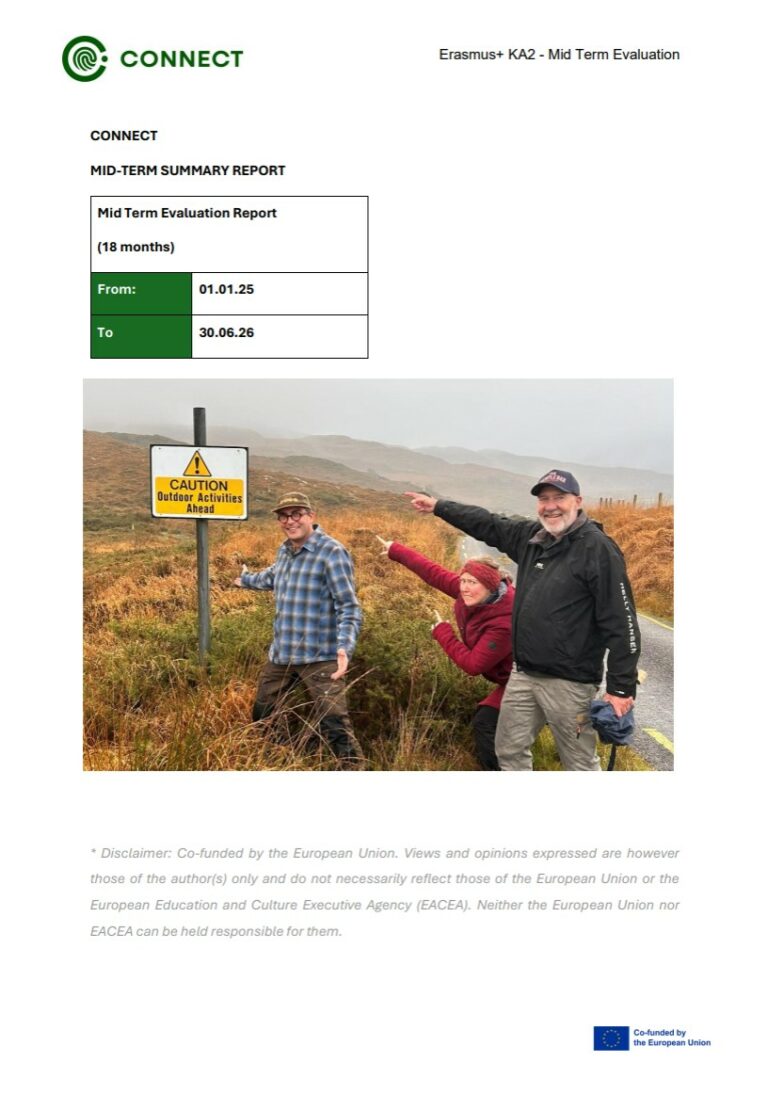
The pilot focused on bringing together outdoor sports practitioners and protected area professionals around the Kerry Seas National Park, to lay the foundations for long-term cooperation. The first pilot was held in Killarney House and Gardens, County Kerry, Ireland, and was hosted by Leave No Trace Ireland in close collaboration with local biodiversity officers.
Discussions centred on the newly designated Kerry Seas National Park, a fragmented marine national park established in 2024 that is still in the development process. Over two days, local outdoor sports providers and community representatives came together to share their experiences, perspectives, and expectations, creating an open dialogue on how collaborative approaches can support both sustainable recreation and future park management.
Outcomes
- Guidance tools and training materials: Resources to help stakeholders implement sustainable practices and foster collaboration.
- Pilot case studies: Insights and lessons learned from engagement in five distinct habitats across Europe.
- Dissemination strategy: Communication materials and activities targeting diverse stakeholders, from local organizations to EU policymakers.
- Stakeholder network: A strengthened transnational network connecting outdoor sports practitioners, environmental managers, and policymakers.
Expected impact:
- Improved collaboration and mutual understanding between outdoor sports organizations and protected area managers.
- Adoption of sustainable practices that protect biodiversity and enhance environmental resilience.
- Increased public awareness of the importance of sustainable outdoor recreation.
- Strengthened policies and strategies for managing outdoor sports in protected areas across Europe.
Reports and other resources